

Our products are handmade with quality materials
With bold patterns, high-quality materials and captivating story-lines of cultures around the globe, each Sapana handicraft is meant to be worn and adored.
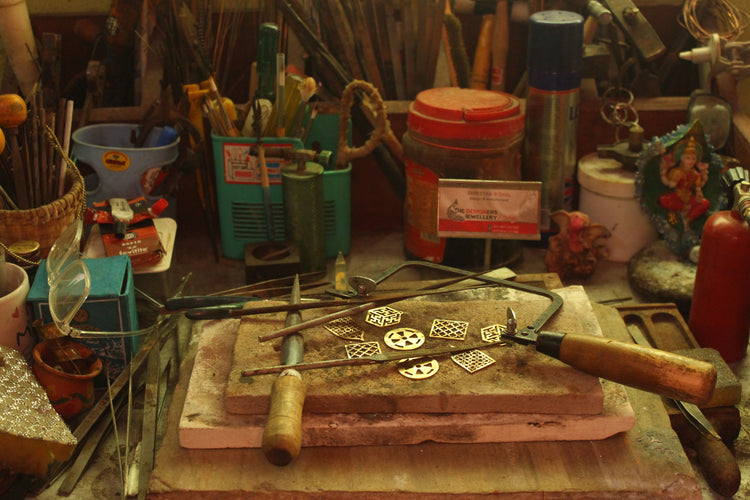
Brass Collection
Our brass pieces are made in India, working with a small family workshop led by Rizwan in Udaipur.
The work is done slowly and traditionally. Shaped by hand, finished with care, and made to be used. These are pieces chosen for their weight, warmth, and quiet presence, not decoration alone.
Each one carries subtle variation, a reminder that it was made by hand — not perfected, not rushed.
Currently available in our Round Top showroom.

Dhurrie Collection
The traditional handicraft of looming dhurries has been practiced for hundreds of years. It’s a skill that is passed on to younger generations from father to son, from mother to daughter.
We work with makers in a small village just outside of Jaipur, India. Horizontal looms are set up outside the artisans’ homes allowing them to work close to their families without having to migrate into urban areas to seek employment.
A large portion of our collection is drawn from patterns you can find in India. We are starting to design our own rugs now, too. The Sapana Original Collection tends to sell fast. If you see it and love it - grab it quick!
Our tailor and their team then work to make what would be a floor covering into your clutch, crossbody or tote.

Sari Collection
Choosing to work with handcrafted or repurposed textiles only is a creative challenge. And one that I enjoy.
Vintage Sari fabrics are truly a connection to the vibrant culture of India. Traveling to India is a visual treat. Color is everywhere - in spices, flowers, architecture, and of course clothing.
Our Dumpling and Darling Bags along with our Camp Shirt Collection are made from silk and silk blend sari fabrics that could have become waste.
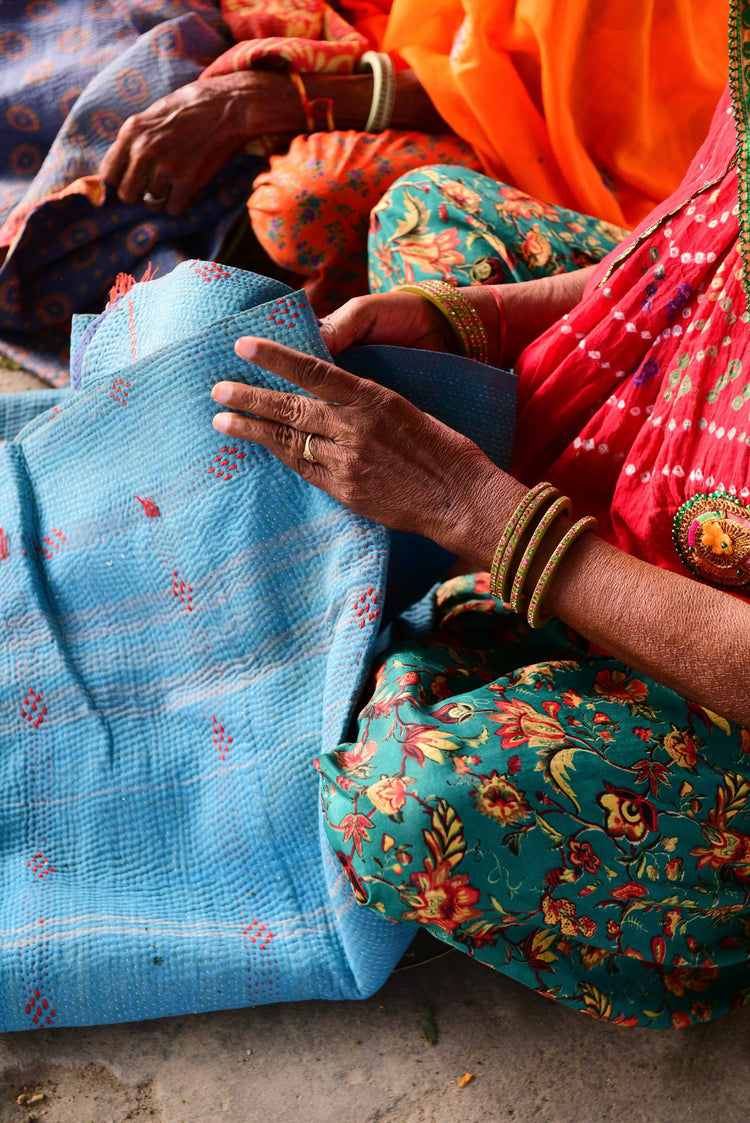
Kantha Collection
Kantha is a traditional textile practice that developed in eastern India and Bangladesh as a practical response to scarcity.
Worn cotton fabrics — often saris or household cloth — were layered together and secured with a simple running stitch. This stitch, now commonly referred to as a kantha stitch, held the layers in place while extending the life of the fabric. The result was a durable, flexible textile used for bedding, wraps, floor coverings, and storage.
.
These pieces were utilitarian by design. They were repaired as needed, patched with available cloth, and added to over time. What distinguishes older kanthas is this accumulation of use — visible stitching paths, areas of dense repair, embroidery added by hand, and small irregularities that reflect both necessity and care.
.
Many kanthas were also made as gifts, created slowly and intentionally for family members. Because of this, they often carry personal details — motifs, color choices, or embellishments — that make each piece distinct.
.
Sapana works with experienced makers in Jaipur and Delhi who specialize in sourcing, assessing, and finishing older kantha textiles. Each workshop brings a different expertise, allowing us to select pieces with strong structure, rich stitching, and visible history.
.
These kanthas form the foundation of our Blanket Coat collection. The designs are intentionally simple, allowing the textile’s age, texture, and construction to remain the focus.
Variation is expected.
History is visible.
No two are ever the same.